Reformer vs Mat Pilates: Choose Your Path with Information
Reformer vs Mat Pilates: Key Differences for an Informed Choice
Pilates is an exercise method that has gained immense popularity for its focus on *core* strength, flexibility, posture, and body awareness. However, as you delve into this world, you'll encounter various options that can lead to questions: Is Mat Pilates or Reformer Pilates better? What do apparatus like the Cadillac or Wunda Chair offer? As a senior writer for PilaPlanner, my goal is to provide you with all the necessary information to make an informed decision, regardless of your level or goals.
Choosing between different types of Pilates isn't about which one is “better,” but rather which one best suits your specific needs. Each modality offers unique benefits and presents distinct challenges, from the accessibility of the mat to the versatility of the apparatus. Understanding these differences is essential to maximize results and fully enjoy your practice.
Mat Pilates: The Foundation of Strength and Body Awareness
Mat Pilates, or Pilates on the mat, is the original and most accessible form of the method developed by Joseph Pilates. It is performed solely using your body weight and, occasionally, with small accessories such as resistance bands, rings, or balls. This modality is the cornerstone of the method, as it requires you to generate all resistance and support from your own musculature.
The essence of Mat Pilates lies in developing a deep mind-body connection. Without the aid or resistance of springs, you must consciously activate your stabilizing muscles, especially the deep abdominal corset (transversus abdominis) and pelvic floor muscles. This improves postural awareness and the ability to control each movement from your body's center. A study published in the *Journal of Bodywork and Movement Therapies* (2018) highlighted that Mat Pilates practice significantly improves *core* activation and lumbar spine stability in healthy individuals.
Benefits of Mat Pilates:
- Accessibility: It's the most economical option, and you can practice it anywhere, whether at home with online classes or in a studio.
- Deep Strength: Strengthens the deep *core* muscles and pelvic floor, essential for spinal stability and injury prevention.
- Body Awareness: Improves proprioception and motor control, teaching you to move with greater efficiency and grace.
- Flexibility and Mobility: Increases joint range of motion and muscle elasticity through controlled stretches.
- Adaptability: While challenging, many exercises can be modified to suit different fitness levels.
However, the lack of external assistance can be challenging for beginners or individuals with physical limitations, as it requires greater control and more refined technique from the outset. Progression largely depends on your own ability to understand and execute the principles of Pilates.
Reformer Pilates: Resistance, Assistance, and Dynamic Versatility
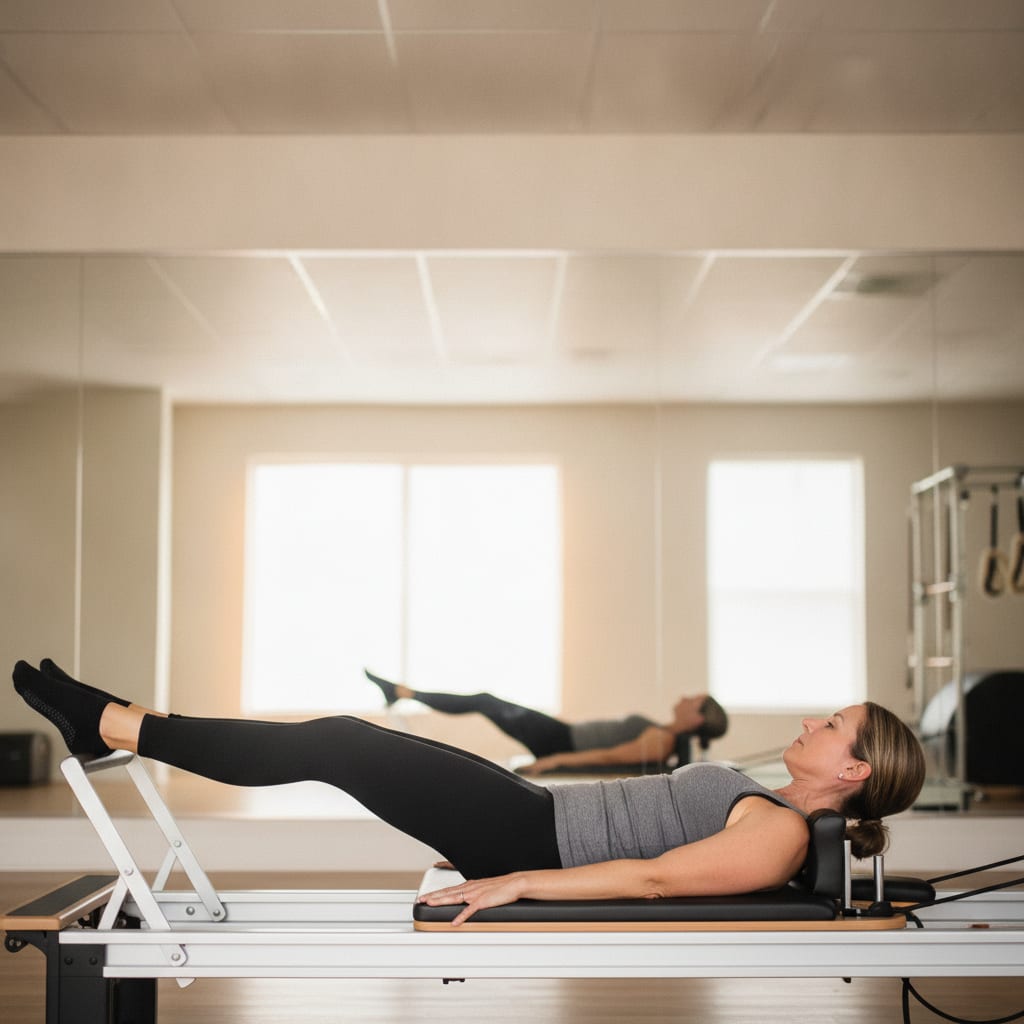
The Reformer is the most well-known and versatile Pilates apparatus, designed by Joseph Pilates to offer a more comprehensive and dynamic workout. It consists of a sliding platform (the carriage) that moves along a frame, connected to a system of springs with varying resistance, straps, and pulleys. This configuration allows for a wide range of exercises in various positions (lying down, sitting, standing, kneeling).
The primary advantage of the Reformer lies in its ability to provide variable resistance and assistance. Springs can make an exercise easier (assistance) or more challenging (resistance), making it ideal for rehabilitation, for individuals with movement limitations, or for athletes seeking a greater challenge. For example, a light spring can aid in a deep stretch, while a heavy one can intensify a strength exercise.
Research in the field of exercise has suggested that certain Reformer exercises can activate *core* musculature up to 30% more than their Mat equivalents, due to the resistance and dynamic challenge offered by the apparatus. This variable resistance allows muscles to be worked eccentrically and concentrically, contributing to balanced muscle development and greater functional strength. However, the same evidence suggests that Mat Pilates practice tends to have greater long-term adherence, possibly due to its accessibility and lower barrier to entry.
Benefits of Reformer Pilates:
- Progressive Resistance: Springs allow for intensity adjustment, making exercises easier or more challenging, which facilitates progression.
- Assistance and Support: Ideal for individuals with injuries or limitations, as the apparatus can assist movement and reduce joint load.
- Greater Exercise Variety: Offers a much broader repertoire than Mat, allowing all muscle groups to be worked from diverse angles.
- Balanced Muscle Development: The uniform resistance of the springs helps strengthen muscles symmetrically, improving posture and reducing imbalances.
- Improved Coordination and Balance: The sliding carriage and springs introduce an element of instability that constantly challenges your control.
The main drawback of the Reformer is the cost, both for classes and the apparatus itself if you wish to own one at home, and it requires the guidance of a qualified instructor for safe and effective use.
Other Pilates Apparatus: Cadillac, Wunda Chair, and Barrel
Beyond the Mat and Reformer, the Pilates method includes other apparatus that offer specific experiences and benefits:
Cadillac (Trapeze Table)
The Cadillac is the largest and most robust Pilates apparatus, similar to an elevated bed with a steel frame that supports bars, springs, and a trapeze. It was originally designed for the rehabilitation of bedridden patients.
- Features: Offers the greatest support and the widest variety of anchor points for springs and straps. It allows for suspension, acrobatic, and spinal decompression exercises.
- Benefits: It is exceptional for rehabilitation, allowing work with a large range of motion and in positions that would be impossible on other apparatus. It promotes spinal decompression, joint mobility, and full-body strength.
- Ideal for: Individuals with severe movement limitations, chronic pain, or those seeking an advanced challenge in flexibility and strength.
Wunda Chair
The Wunda Chair is a compact apparatus consisting of a seat with a movable pedal connected to springs. It is known for its ability to intensely challenge strength and balance.
- Features: Its compact design makes it ideal for small spaces. Exercises are performed seated, standing, or in more complex positions, using the pedal for resistance.
- Benefits: Powerfully strengthens legs, glutes, *core*, and arms. Improves balance, coordination, and stability, especially in standing positions.
- Ideal for: Athletes, dancers, and those seeking a very specific and challenging strength and balance workout.
Barrels (Ladder Barrel and Spine Corrector)
Barrels are apparatus with curved surfaces designed to support the spine and improve its flexibility and articulation.
- Features: The Ladder Barrel combines a ladder with a padded barrel. The Spine Corrector is smaller and more portable.
- Benefits: They are excellent for mobilizing the spine in flexion and extension, improving posture, stretching back muscles and hamstrings, and strengthening the *core*.
- Ideal for: Improving spinal mobility, relieving lower back tension, and working on thoracic extension.
Criteria for Choosing Your Ideal Pilates: Mat, Reformer, or Apparatus?
Choosing the most suitable Pilates modality for you will depend on several personal factors. Here's a guide to help you make the best decision:
Your Personal Goals
- Fundamental Strength and Body Awareness: If you're looking to build a solid foundation, improve your posture, and learn the principles of Pilates, Mat is an excellent starting point. It will teach you to activate your *core* without external assistance.
- Rehabilitation, Support, or Rapid Progression: If you have an injury, chronic pain, or need additional support, the Reformer or Cadillac are ideal. They allow you to work with controlled assistance and resistance, facilitating recovery and safe strengthening.
- Advanced Challenge, Balance, and Specific Strength: If you already have experience and are looking to intensify your workout, the Wunda Chair or advanced Reformer will offer a great challenge.
- Spinal Mobility and Flexibility: The Barrels are perfect for working on spinal articulation and safely increasing flexibility.
Physical Conditions or Injuries
- Lower Back Pain: Both Mat (with modifications) and Reformer can be beneficial. The Reformer, with its capacity for assistance, may be safer initially to avoid compensation. A study in *Journal of Physical Therapy Science* (2016) showed that Pilates (both Mat and Reformer) is effective in reducing chronic lower back pain and improving function.
- Diastasis Recti or Prolapse: It is crucial to work with a specialized instructor. The Reformer can allow for more controlled and safe progression, avoiding excessive intra-abdominal pressure.
- Osteoporosis: Exercises must be adapted to avoid excessive spinal flexion. The Reformer and Cadillac can offer more options for safe exercises in extension and strengthening of supporting musculature.
Budget and Accessibility
- Economical and Home-Based: Mat Pilates is, by far, the most accessible option. You only need a mat and can follow online classes.
- Studio Investment: Classes with the Reformer and other apparatus are usually more expensive due to equipment costs and the need for more personalized instruction (small group or individual classes).
Experience Level
- Beginners: Mat is excellent for learning the fundamentals. The Reformer is also highly recommended for beginners, as the assistance of the springs and instructor guidance facilitate correct movement execution.
- Intermediate and Advanced: All modalities offer challenging progressions. Combining Mat and apparatus can provide a very comprehensive workout.
Hypopressives vs. Kegel: Where Do They Fit in Pilates?
It's common for questions to arise about how Hypopressives and Kegel exercises relate to Pilates. It's important to clarify that neither Hypopressives nor Kegel are Pilates exercises per se, but all aim for pelvic floor and abdominal corset health, and they can complement each other.
Kegel Exercises
Kegel exercises involve the voluntary and isolated contraction and relaxation of the pelvic floor muscles. They are useful for strengthening this musculature in cases of stress urinary incontinence or to improve tone. However, they are not “good for everyone” and should be prescribed by a specialized physical therapist, as in cases of excessive tension (hypertonia), they can be counterproductive.
Hypopressives
The hypopressive technique is based on specific postures and breathing (expiratory apnea) that causes a reflexive and involuntary activation of the deep abdominal corset and pelvic floor muscles, reducing intra-abdominal pressure. They are effective for postpartum rehabilitation, diastasis recti, and improving pelvic floor tone.
Pilates and the Pelvic Floor
Pilates, at its core, integrates pelvic floor and transversus abdominis activation with breath and movement. During a Pilates exercise, the goal is a functional and coordinated activation of these muscles, not an isolated contraction like in Kegels, nor an apnea like in Hypopressives. Pilates teaches you to use your pelvic floor dynamically in your daily life, which complements both techniques. A qualified Pilates instructor will know how to adapt exercises to protect and strengthen your pelvic floor, especially on the Mat and Reformer, where *core* control is fundamental.
Frequently Asked Questions About Pilates Modalities
Can I do Pilates at home without equipment?
Yes, absolutely. Mat Pilates is perfect for practicing at home. Numerous online classes and resources are available to guide you. It's an excellent way to start and learn the fundamental principles of the method. While you won't have the resistance or assistance of the apparatus, you will develop great internal strength and body awareness.
Which is better for weight loss?
Pilates, in any of its modalities, is an excellent tool for toning the body, improving body composition, and increasing basal metabolism due to increased muscle mass. However, it is not an intense cardiovascular exercise. For weight loss, the most effective approach is to combine Pilates with a balanced diet and some form of regular cardiovascular exercise. Pilates will help you build a strong and functional body for any other activity.
Do I need prior experience to use the Reformer?
No, you do not need prior experience. The Reformer is very versatile and adaptable for all levels, including beginners. The assistance of the springs can even facilitate the correct execution of movements for those just starting, and a good instructor will guide you step-by-step. Many studios offer introductory classes to familiarize you with the apparatus.
Can I combine different types of Pilates?
Yes, and it is highly recommended! Combining Mat Pilates with Reformer or other apparatus classes will provide you with a more complete and balanced workout. For example, Mat will help you maintain your fundamental strength and body awareness, while the Reformer will allow you to work with resistance and explore a broader repertoire of movements. This combination can enhance your results.
Which type of Pilates is best for lower back pain?
Both Mat and Reformer can be very beneficial for lower back pain, always under the supervision of a qualified instructor. Pilates strengthens the *core* and improves posture, which relieves pressure on the spine. For acute cases or intense pain, the Reformer can offer more support and control, allowing for safer rehabilitation. In cases of chronic pain, both Mat and Reformer can be effective in improving strength, flexibility, and reducing pain, as demonstrated by studies in the *Revista Española de Salud Pública* (2018) on the effectiveness of Pilates for chronic low back pain.
When to Consult a Healthcare Professional
Although Pilates is a safe and adaptable method, it is crucial to listen to your body and seek professional advice in certain situations:
- Acute or Persistent Pain: If you experience pain that does not improve with rest or worsens during exercise, consult a doctor or physical therapist before continuing.
- Recent or Chronic Injuries: If you have an injury (back, knee, shoulder, etc.) or a chronic condition (herniated disc, osteoarthritis, severe osteoporosis, fibromyalgia), it is essential that your doctor or physical therapist gives you clearance and that you inform your Pilates instructor.
- Pregnancy and Postpartum: During these stages, your body undergoes significant changes. It is crucial to have medical approval and work with an instructor specialized in prenatal or postpartum Pilates, who knows how to adapt the exercises.
- Specific Pelvic Floor Conditions: In cases of urinary or fecal incontinence, pelvic organ prolapse, or diastasis recti, an evaluation by a specialized pelvic floor physical therapist is essential. They will advise you if Pilates is suitable and how to adapt it.
- Dizziness, Nausea, or Extreme Fatigue: If you experience any of these symptoms during or after practice, stop and consult a professional.
This content is for informational purposes only and does not substitute for the assessment of a healthcare professional. Exercises are performed at your own risk. Always consult with a qualified professional before starting a new routine.