Pilates at home: the classic abdominal series
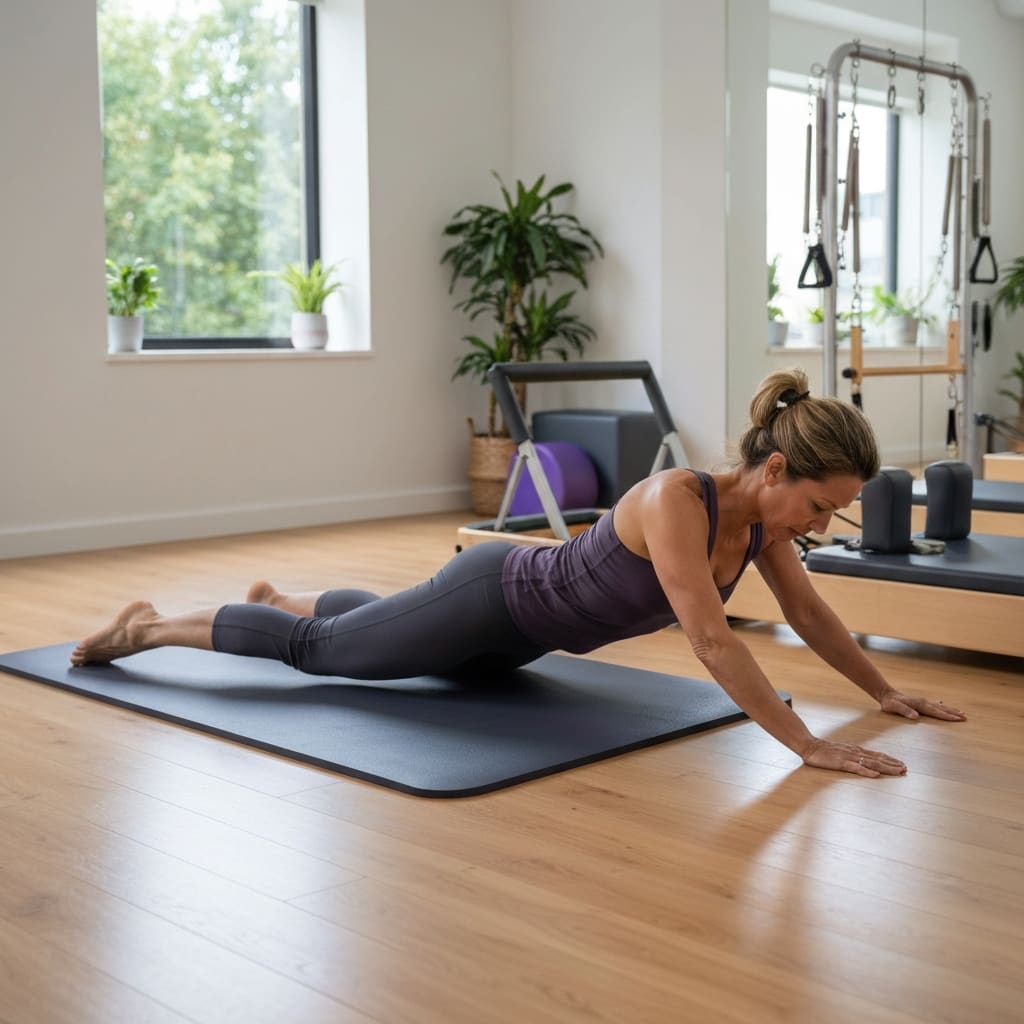
Pilates at home: the classic abdominal series
The classic Pilates abdominal series is a complete routine to strengthen your core and improve your posture. You can do it at home without any equipment and, with regular practice, you will notice more control and stability in your torso.
Getting ready
Find a comfortable spot with a padded surface, like a mat or a folded towel. Before starting, warm up briefly with gentle neck, shoulder and hip mobility, plus a few deep breaths to wake up your abdomen.
The classic abdominal series
This series usually includes six exercises: Hundred, Roll-up, Single Leg Stretch, Double Leg Stretch, Criss-Cross and Teaser. Below I explain each one with options to make it easier or harder, and a few precautions if you have abdominal diastasis (separation of the abdominals).
Hundred
Basic level: Lie on your back with your knees bent in a tabletop position. Slightly lift your head and shoulders, stretch your arms along your body and do small pumping movements with them while breathing in a controlled way.
What you feel: activation in the abdominal area and a focus on the breath.
Easier: Rest your head on the mat or bring your legs closer to your body.
Caution: If you have abdominal diastasis, keep your ribs in check, activate the deep abdomen and avoid lowering your legs too much.
Roll-up
Basic level: Lie on your back with your legs straight and arms reaching forward. Inhale and, as you exhale, slowly roll up until you are sitting. Then return down slowly, rolling the spine bone by bone.
What you feel: a stretch in your back and work in the abdomen.
Easier: Slightly bend your knees or use your hands to help you up and down.
Single Leg Stretch
Basic level: Lie on your back, draw one knee to your chest holding it with your hands and extend the other leg. Alternate sides with control.
What you feel: abdominal activation and control while switching legs.
Easier: Do not lift your head and shoulders so much, and shorten the reach of the extended leg.
Double Leg Stretch
Basic level: Lie on your back with both knees to your chest. Stretch arms and legs out in diagonals and bring everything back together with control.
What you feel: overall work in the abdomen and coordination with the breath.
Easier: Do a shorter range or keep your head down if you feel tension in the neck.
Criss-Cross
Basic level: Lie on your back with your hands behind your head. Bring one elbow toward the opposite knee and alternate with a smooth, controlled movement.
What you feel: work along the sides of the abdomen and rotation of the torso.
Easier: Rest your head or shorten the rotation if you feel discomfort.
Teaser
Basic level: From lying down, lift your torso and legs at the same time to form a "V". Hold a few seconds and lower with control.
What you feel: strong abdominal work, control and balance.
Easier: Do a shorter version by slightly bending your knees or only lifting the torso.
15-minute routine
You need: no extra equipment. Level: all levels, with adaptations.
- Hundred — 10 reps or as long as you can keep control.
- Roll-up — 8 to 10 reps.
- Single Leg Stretch — 10 reps per leg.
- Double Leg Stretch — 8 to 10 reps.
- Criss-Cross — 10 reps per side.
- Teaser — 5 to 8 reps or an adapted version.
When you finish, mild fatigue in the abdomen is normal. If you feel pain, back discomfort or a sensation of excessive pressure, stop and review your technique.
When to seek help
Consult a healthcare professional if you feel pain during or after the session. It is also a good idea to ask for guidance if you are pregnant, in the postpartum period or if you have any pre-existing medical condition.
Frequently asked questions
What is the classic Pilates abdominal series?
It is a sequence of mat exercises focused on the abdomen, torso control and posture.
How long does it take?
Usually 10 to 20 minutes, depending on your level and the number of reps.
Can it be done at home?
Yes, you can do it at home without any extra equipment.
Is it suitable during pregnancy?
Before practising it, the best option is to check with a healthcare professional.
Can it be adapted to each level?
Yes, every exercise can be made gentler or more challenging.
This content is informative and does not replace the assessment of a healthcare professional. The exercises are performed under your own responsibility. Always consult a qualified professional before starting a new routine.