Exercise and Perimenopause: Strengthen Your Bones and Beyond
Perimenopause Exercise: Key to Bone Health and Well-being
Perimenopause is a stage of significant changes in a woman's body, marked by the fluctuation and eventual decline of estrogen. This natural process, which typically begins between ages 40 and 50, directly impacts your bone density, muscle mass, metabolism, and overall well-being. Far from being a sentence, it's a crucial time to take charge of your health through exercise and nutrition. Strength training, in particular, has proven to be a powerful tool for protecting your bones and mitigating other symptoms associated with this transition.
Scientific evidence supports that strength training during menopause significantly reduces the risk of osteoporotic fractures, according to the European Menopause and Andropause Society (EMAS). It's not just about “staying active,” but about choosing the right type of exercise with knowledge and rigor.
Understanding Bone Loss: Osteopenia and Osteoporosis
During perimenopause and menopause, declining estrogen levels accelerate bone mass loss. Estrogen plays a role in maintaining your bone density, and its decrease causes the process of bone resorption (breakdown of old bone) to be faster than new bone formation. This can lead to conditions like osteopenia and, in more advanced cases, osteoporosis.
- Osteopenia: This is diagnosed when your bone mineral density (BMD) is lower than normal, but not low enough to be classified as osteoporosis. It is defined by a T-score between -1 and -2.5 standard deviations, according to World Health Organization (WHO) criteria.
- Osteoporosis: This is a skeletal disease characterized by decreased bone mass and deterioration of bone tissue microarchitecture, which increases bone fragility and fracture risk. Diagnosis is established with a T-score equal to or below -2.5 standard deviations, according to the WHO.
Osteoporosis is a significant concern: one in three postmenopausal women will suffer an osteoporotic fracture, according to EMAS and the International Osteoporosis Foundation (IOF). These fractures, especially of the hip, spine, and wrist, can have a devastating impact on quality of life and independence.
The Role of Adapted Exercise in Bone Health and Beyond
Physical exercise, when chosen and executed correctly, is one of the most effective interventions for preventing and managing bone loss. It not only strengthens your bones but also helps combat muscle mass loss (sarcopenia), improves cardiovascular health, manages weight, and can alleviate symptoms like hot flashes.
Key Exercise Mechanisms for Your Bones:
- Mechanical Loading: Exercises involving axial loading (weight passing through the axis of your body, such as standing or lifting weights) or impact (like brisk walking or gentle jumps) stimulate bone cells to form new tissue. This process, known as mechanotransduction, is essential for maintaining bone density.
- Muscle Strengthening: By strengthening your muscles, you not only improve your ability to move but also apply tension to your bones through tendons, which contributes to their density. Additionally, strong muscles improve balance and coordination, reducing the risk of falls and, consequently, fractures.
- Improved Balance: Estrogen loss can also affect balance. Specific balance exercises are crucial for preventing falls, which are the leading cause of fractures in people with osteoporosis.
Essential Contraindications and Precautions for Osteoporosis
If you have osteopenia or osteoporosis, it's crucial to adapt your exercise routine to protect your spine and other joints. Certain movements can increase the risk of fractures, especially in the spine.
- Marked forward spinal flexion: Avoid exercises that involve significantly curving your back forward, such as the classic Pilates Roll-up without modification, or extreme forward spine stretches. These movements can generate excessive pressure on the vertebrae, increasing the risk of vertebral wedge fractures.
- Abrupt or loaded rotations: Rapid or forced trunk rotations, especially when combined with flexion, should be avoided. Opt for gentle, controlled rotations, keeping the spine elongated.
- High impact without supervision: While low-to-moderate impact is beneficial, very high jumps or high-impact exercises without proper technique and supervision can be detrimental.
- Lifting excessive weights without proper technique: Axial loading is good, but lifting very heavy objects with poor posture or without proper muscle activation can be dangerous.
Always consult with your doctor and a physical therapist or specialized Pilates instructor before starting any exercise program, especially if you have a diagnosis of osteopenia or osteoporosis.
Evidence-Based Exercises for Bone Health
The most effective exercise programs for bone health combine strength training, controlled axial loading exercises, gentle torso and lower back extensions, and balance work.
- Strength Training with Controlled Axial Loading: Use weights, resistance bands, or your own body weight. Examples include squats, light Romanian deadlifts, dumbbell shoulder presses, and rows. The LIFTMOR method (High Intensity Resistance and Impact Training), supervised by professionals, has shown promising results in increasing bone density in postmenopausal women.
- Gentle Torso-Lumbar Extensions: Strengthening back muscles helps maintain an upright posture and protect the spine. Exercises like the modified Pilates 'Swan Dive' (only lifting head and chest, without hyperextension) or gentle quadruped lumbar extensions are excellent.
- Balance Exercises: Standing on one leg, heel-to-toe walking, or using unstable surfaces (with caution) improves proprioception and reduces the risk of falls.
- Low to Moderate Impact: Brisk walking, climbing stairs, dancing, or low-impact aerobic exercises stimulate bone formation.
Adapted Therapeutic Pilates for Bone Health
Pilates, with its principles of control, precision, and fluidity, is an excellent tool for bone health when adapted. It focuses on core stability, strengthening deep musculature, and improving posture, all of which are crucial for preventing fractures.
- Emphasis on axial extension: Instead of flexion, spinal lengthening is prioritized, strengthening the back extensor muscles.
- Controlled loading: Use reformer springs, your own body weight, or small weights to apply resistance safely.
- Improved balance and proprioception: Many Pilates exercises challenge balance and body awareness, which is vital for preventing falls.
Adapted Exercise Routine for Bone Health
This routine combines strength and Pilates elements, adapted for bone health. Perform it 2-3 times per week, allowing a rest day between sessions. Remember that progression should be gradual and always under professional supervision if you have osteoporosis.
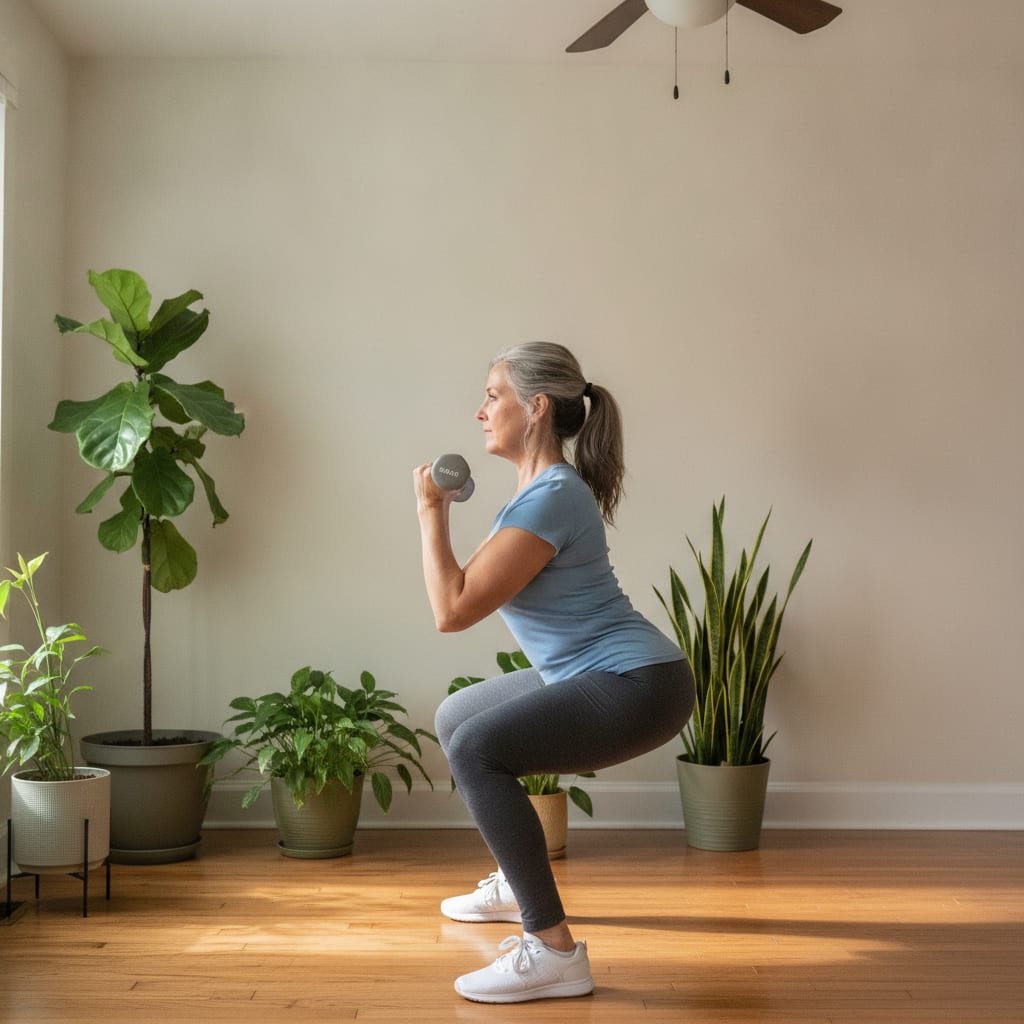
Modified Squat
Basic level: Stand with your feet hip-width apart, toes slightly turned out. Slowly lower as if sitting in a chair, keeping your back straight and chest upright. Your knees should follow the direction of your feet and not go past your toes. Return to the starting position. Do 3 sets of 10-12 repetitions.
What you'll feel: Work in glutes and thighs, a sense of stability in the legs.
Easier: Use an actual chair to sit down and stand up, controlling the movement.
More advanced: Hold a light dumbbell at chest height (goblet squat) or increase repetitions.
Caution: Maintain a neutral spine, avoid curving your lower back.
Shoulder Bridge (Bridge)
Basic level: Lie on your back with knees bent and feet flat on the floor, close to your glutes. Slowly lift your pelvis off the floor, vertebra by vertebra, until you form a straight line from your shoulders to your knees. Hold the position for a few seconds and lower with control. Do 3 sets of 10-12 repetitions.
What you'll feel: Activation of glutes and hamstrings, gentle stretch in the front of the hips.
Easier: Perform a smaller range of motion, only slightly lifting the pelvis.
More advanced: Hold the position a little longer, or lift one leg extended towards the ceiling while keeping the hips elevated.
Caution: Avoid excessively arching your lower back when lifting. Keep your pelvis stable.
Resistance Band Row
Basic level: Sit on the floor with your legs extended or slightly bent. Loop a resistance band around the soles of your feet and hold the ends with your hands. Keep your back straight and core engaged. Pull the band towards you, drawing your elbows back and squeezing your shoulder blades together. Return slowly. Do 3 sets of 10-12 repetitions.
What you'll feel: Work in the upper back (lats, rhomboids) and shoulders.
Easier: Use a band with less resistance.
More advanced: Use a band with greater resistance or perform the exercise standing, leaning slightly forward (if there's no contraindication for spinal flexion).
Caution: Keep your spine long and avoid hunching your shoulders forward.
Quadruped Spinal Extension (Modified Bird-Dog)
Basic level: Start on all fours, with hands under your shoulders and knees under your hips. Maintain a neutral spine. Extend one arm forward and the opposite leg back, keeping your abdomen contracted to stabilize your pelvis and back. Avoid arching your back. Return to center and switch sides. Do 3 sets of 8-10 repetitions per side.
What you'll feel: Strengthening of the core, glutes, and back, improved balance and coordination.
Easier: Extend only one arm or only one leg, without lifting both at once.
More advanced: Hold the position for a few seconds with each extension.
Caution: Avoid hyperextension of the lower back. Keep your core engaged to protect your spine.
Heel Raises (Calf Raises)
Basic level: Stand with your feet hip-width apart and hands lightly resting on a wall or chair for balance. Slowly lift your heels off the floor, coming onto your tiptoes. Lower with control. Do 3 sets of 15-20 repetitions.
What you'll feel: Work in the calf muscles and improved balance.
Easier: Reduce the range of motion or do fewer repetitions.
More advanced: Perform the exercise on a step for a greater range of motion or do it on one leg.
Caution: Keep the movement controlled and avoid bouncing.
Complementary Nutrition for Strong Bones
Exercise is a pillar, but nutrition plays an equally important role. For bone and muscle health during perimenopause, consider:
- Calcium: The recommended intake for postmenopausal women is 1200 mg/day. Sources include dairy, dark leafy greens, legumes, and some nuts.
- Vitamin D: This is crucial for calcium absorption. An intake of over 800 IU/day is recommended. Controlled sun exposure and foods like fatty fish, egg yolks, or fortified foods are sources. A supplement may be necessary, always under medical supervision.
- Protein: To combat muscle mass loss (sarcopenia) and support bone health, an intake of 1.2 g of protein per kilogram of body weight per day is advised. Include lean sources such as meat, fish, eggs, legumes, and dairy in every meal.
Frequently Asked Questions
Is Pilates safe if I have osteoporosis?
Yes, Pilates can be very safe and beneficial if you have osteoporosis, provided it is adapted by a qualified instructor. Movements involving marked forward spinal flexion and abrupt rotations should be avoided, prioritizing axial extension and strengthening of the core and postural muscles. A good instructor will know how to modify exercises to protect your spine and enhance safe bone loading.
What type of exercise is best for preventing bone loss?
Strength exercises with controlled axial loading and low-to-moderate impact exercises are most effective for stimulating bone formation. This includes lifting weights, using resistance bands, brisk walking, climbing stairs, and balance exercises. Combining these types of training offers the best results.
How much exercise should I do per week for bone health?
To gain significant benefits for bone health, it is recommended to perform strength training 2-3 times per week, with at least one rest day between sessions. Additionally, it is advised to include low-to-moderate impact aerobic activity most days of the week, totaling at least 150 minutes weekly.
Are Kegels useful for bone health in perimenopause?
Kegel exercises are designed to strengthen the pelvic floor muscles and are important for preventing or treating urinary incontinence and prolapse. While beneficial for pelvic health, they do not have a direct impact on overall skeletal bone mineral density. For bone health, you need exercises that involve axial loading and full-body strength.
Can I reverse osteoporosis with exercise?
While it is difficult to completely reverse osteoporosis to a normal T-score with exercise alone, appropriate training can significantly slow the progression of bone loss, maintain or even slightly increase bone mineral density in some areas, and drastically reduce the risk of fractures. It is an essential part of managing the condition, along with medication if your doctor deems it necessary.
When to Consult a Professional
It is crucial to consult with healthcare professionals if you experience:
- Persistent pain: Especially in your back, hips, or wrists, which could indicate a fracture.
- Height loss: If you notice you've lost several centimeters in height in a short period, it could be a sign of vertebral compression fractures.
- Postural changes: Such as an excessive curvature of the upper back (kyphosis).
- Diagnosis of osteopenia or osteoporosis: You will need a medical evaluation for a comprehensive treatment plan that may include medication, supplements, and a supervised exercise program.
- Uncertainty about safe exercises: If you are unsure how to adapt your routine, seek a physical therapist specializing in women's health or older adults, an endocrinologist, or a rheumatologist. They can offer personalized and safe guidance.
This content is for informational purposes only and does not replace the assessment of a healthcare professional. Exercises are performed at your own risk. Always consult with a qualified professional before starting a new routine.